Coralie is thirteen years old and lives on Christmas Island, where sea birds circle the sky and the seasons are marked by the migratory patterns of crabs. But life on the island isn’t always paradise.
During a fierce tropical storm, a fishing boat carrying eighty-nine asylum seekers crashes into the island’s cliffs. Coralie locks eyes with Ali, an eleven-year-old Iranian boy, as his mother pulls her life jacket over his head. But soon Ali disappears beneath the waves and when his body isn’t recovered, Coralie resolves to do everything she can to find him.
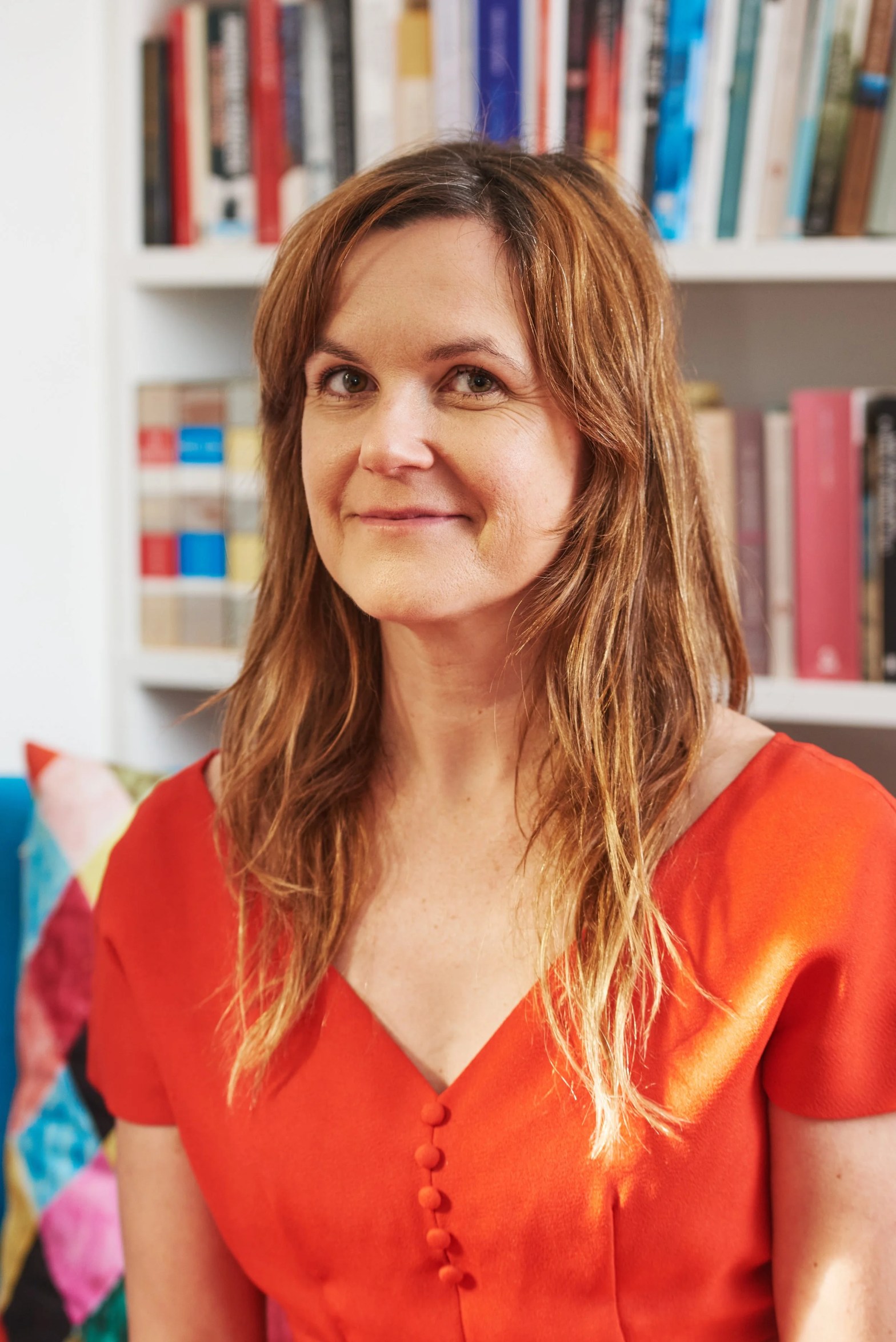
Pip Smith is a writer, reviewer, mother, teacher and manager of the Faber Writing Academy by day. Singer and strummer of guitars in garage band Imperial Broads by night. Her books include the children’s picture books Theodore the Unsure,and To Greenland!, the novel Half Wild, and poetry collection Too Close for Comfort.
Q&A

How did you decide on The Pull of the Moon as a title?
Actually, the title was one of the first things that came to me, and it came as I was writing the grant application for the book. I already knew a little about Christmas Island after having visited the place in January 2010, and as I sat down to write my application, I wanted to capture the feeling I had when I was there: that the island is a rock in the sea around which so much movement flows. ~60 million crabs are moved through their migratory patterns by the moon, as are the tides, which control other migratory patterns.
So many of us would only think of human migration when we think of Christmas Island, and yet it is a nexus point for so many species on the move, and so much of that is controlled by the moon. But the title carries other symbolic weight, too. Much of the island looks like a moonscape, after being subjected to extensive mining. It got me thinking – are we slowly turning our planet into a moon-like rock, devoid of plants and animals? So I guess “the pull of the moon” refers to the pull our species are inflicting on the planet – we are pulling it further towards a lunar desert than perhaps we care to admit.
The plot centres on the crash of a boat carrying eighty-nine asylum seekers, as witnessed by Coralie, our 13-year-old protagonist. I found this scene incredibly riveting but also (rightfully) horrifying. What was your approach to writing such a confronting scene for a young audience?
I tried to stick as closely as possible to the scene as it was described by witnesses during the senate inquiry, but I also tried to focalise as much as possible through fictional Coralie’s eyes. It’s the one scene in the novel that is 90% true. The man being dashed against the rocks as he tried to make the leap to shore, the time it took the navy to arrive – I wanted to honour all of this, though the Australian characters watching from the shore are made up.
I really enjoyed the complexity of Coralie’s mother (Hannah) as a character, and I enjoyed the scenes from her points of view. In my experience with MG and YA, we don’t often get an adult’s point of view. Why was it important to you to include Hannah’s in this story?
I’m glad you liked her chapter! It is a favourite of mine too. I was inspired to write that chapter after listening to the audiobook of Blueback on my way to a writing retreat. I had already shared the novel with my agent at the time, and her feeling was that the mother’s story was not complete. This confirmed a feeling I had about the book, but was trying to ignore. Listening to Blueback (which ends with a shift to the mother’s perspective) gave me the permission to make that bold leap and switch to the mother’s POV. I find many of the rules of YA and MG fiction very limiting. As soon as someone tells me a story needs to be told from a 15 year old’s POV, or that you can’t hop heads, I instantly want to break those rules. I wrote Hannah’s chapter all in one go after giving myself permission to try it. Without it, I felt it was too easy to dislike Hannah. With it, we can begin to understand the choices she made.
There are chapters in the book from the perspectives of Ali and Zahra, the Iranian children who came on the boat. How did you approach writing from their points of view?
I did A LOT of research. I read as much Iranian fiction in translation, or fiction by the Iranian diaspora as I could get my hands on. I interviewed people, and I tried to learn Farsi! After all this faffing around (which was important, but it felt like procrastination at the time), I just bit the bullet and tried to write scraps of scenes I could stitch together into chapters. At first I told myself it was an imaginative exercise that wasn’t going to end up in the book. But eventually the characters stuck and I couldn’t shake them.
Reading this book, I realised I knew very little about Christmas Island. Is there anything you wish more people would know or understand about the island?
So much! I urge people to visit the place for themselves. It boasts some of the best diving in Australia! And the bird watching, the crab migration, all of the natural events that take place there are worth seeing in the flesh. But I think it’s really important to know that there are ~1000 Australian locals living there – of all kinds of ethnic backgrounds. It’s a really multicultural place, with a unique collective culture unlike any I’ve ever encountered in other Australian cities. Those locals were on the frontline of much of Australia’s “border security” history of the early 2000s, and saw much that was kept hidden from the rest of us mainlanders.
What do you hope readers will take away from The Pull of the Moon?
I hope they have an appreciation of Christmas Island as an uncanny, vibrant place that humans and animals have flowed through for thousands of years. I hope it encourages younger people to ask questions about migration and who gets to decide who lives in our country and “the manner in which they come”. I’d love it to be a tool for thinking and feeling their way through Australia’s tricky recent history.
The Pull of the Moon is out now through UWA Publishing
Support the Show
Has Novel Feelings entertained you, or taught you something? Show your support with a once-off donation by buying us a coffee. All proceeds go towards making the show stronger and more sustainable for the future.
We record our podcast on Wurundjeri Land, which is home to both of us in Naarm/Melbourne. We also acknowledge the role of storytelling in First Nations communities. Always was, always will be Aboriginal Land.
 Novel Feelings