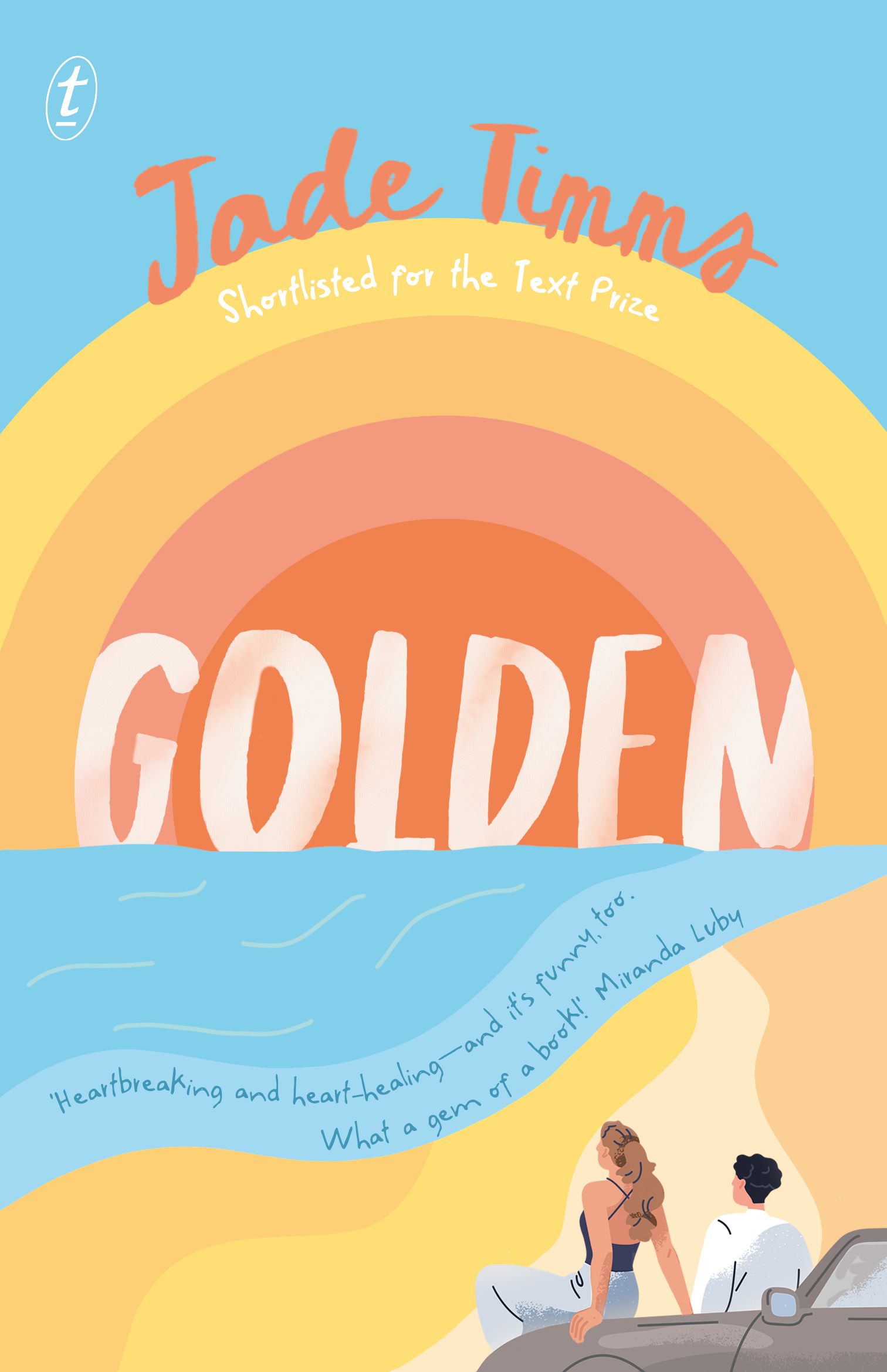
Golden is a warm-hearted optimistic story about friends and friendship and art and beauty—and the power of letting yourself be loved…
When you work in the juice bar of your small coastal town. When your twin brother is the fun one with all the friends. When something happened a year ago that you can’t talk about, but everything makes you remember it. When it might have been all your fault. When going to the beach, to that beach, takes all the air out of your lungs. When you’re training for the town’s annual Mud Run that you’re not even sure you want to enter. When you’re drawn to colours and pencils and paint, but you’re not an artist. When the new guy in town, the one who makes you feel you’re charged with electricity, seems to want to hang out with you.
When it comes time to let your friends back in.
Review
Jade Timms’ Golden is a quiet, slow-burning exploration of grief, trauma, and the messy process of healing. Set against the seemingly idyllic backdrop of a laid-back Australian beach town, the novel follows Eddie, a teenage girl deeply hurting after the aftermath of a traumatic event. On the surface, it’s a coming-of-age story with friendships, family tensions, and first love. But Golden is also a raw and emotionally honest portrait of what it means to be living with undiagnosed post-traumatic stress disorder (PTSD).
The narrative convincingly captures Eddie’s symptoms of PTSD: intrusive memories, emotional numbness, and distorted thinking. She has withdrawn from her friends and clashes constantly with her family, and often assumes the worse about other people’s motivations.
As a reader, it can be uncomfortable and at times frustrating to witness Eddie push others away and misread their intentions. The author doesn’t romanticise the experience of trauma, nor does she offer an easily resolved arc. Eddie’s pain is real and her behaviour, while difficult at times, is understandable given her circumstances. The book reminds us that healing isn’t a straight line – and that people navigating trauma may not always act in ways that are easy to sympathise with.
One of the novel’s strongest elements is the depiction of Eddie’s family, all of whom are grieving. Her estranged relationship with her twin brother Pat – with whom she used to be close – is explored with care, and ends on a satisfying note. Her relationship with her older sister Viv is fascinating, and the tension with their mother is palpable. The novel also boasts a large cast of teenage characters, some of whom were difficult to place as they often appeared without introduction. Their presence helped to contextualise Eddie’s isolation — a reminder of the connections she’s lost, and those she might still rebuild.
The Mud Run – a physically demanding obstacle course that Eddie trains for throughout the book – is clearly analogous to her emotional pain. The training is painful, exhausting, and full of challenges, but ultimately a demonstration of her strength.
Golden doesn’t offer neat resolutions or easy lessons. Instead, it offers a compassionate portrayal of a young person trying to make sense of loss and ultimately rebuild her connections.
Thank you to Text Publishing who provided a copy of the novel in exchange for a review.
Review by Elise
Has Novel Feelings entertained you, or taught you something? Show your support with a once-off donation by buying us a coffee. All proceeds go towards making the show stronger and more sustainable for the future.
 Novel Feelings