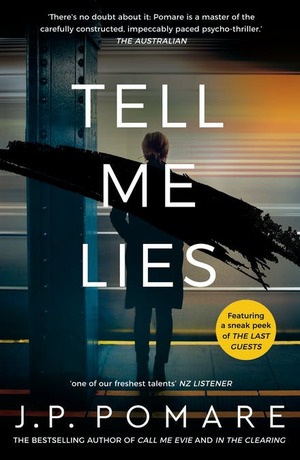
Psychologist Margot Scott has a picture-perfect life: a nice house in the suburbs, a husband, two children and a successful career.
On a warm spring morning Margot approaches one of her clients on a busy train platform. He is looking down at his phone, with his duffel bag in hand as the train approaches. That’s when she slams into his back and he falls in front of the train.
Margot’s clients don’t always tell the truth, but now one lie could cost her family and freedom.
Major spoilers ahead!
Review
Tell Me Lies is a fast-paced, fairly slim book. As a thriller, it keeps you on the edge of your seat and turning the pages. There is an intricate web of deception, a main character who you can’t trust, and plenty of twists – the plot remains intriguing even though you’ve been told how it ends: with a psychologist pushing a client onto the path of a train. For the typical thriller reader, this book will likely be an engaging read. For me, the reading experience was an irritating one.
Essentially (and I’m about to spoil the entire plot, so proceed at your own risk), the book revolves around Margot Scott, who started seeing a client named Cormac, a young man who has been cheating at university. Cormac is clearly attracted to her, and Margot starts crossing boundaries until they kissed. Along the way, a number of alarming things happen to Margot and her family: their house is attacked by an arsonist; disturbing pictures are sent to them; etc. It became clear that someone is targeting Margot, and that someone is Cormac. It accumulated into a kidnap and attempted murder, and it’s revealed that Cormac is the son of Margot’s past client, Peter. Peter had been diagnosed with bipolar disorder and was suicidal. Margot was doing home visits and neglecting to record them, and continued seeing him even though she knew that he was attracted to her. They slept together, and she then broke up with him. He threatened suicide and, while surrounded by police, asked to speak to Margot. He ended up dying by suicide (the big reveal at the end of the book is that Margot encouraged him to do so in his last moments, knowing that her career would be over if other people found out the extent of their relationship). The other big reveal at the end is the implication that Margot very likely has Antisocial Personality Disorder (I checked the DSM-V to be sure, and this is a diagnosis that can also be referred to as psychopathy or sociopathy), and that her father, who had also been a psychologist, had suspected it when she was a child.
Bad therapy/therapist is a common trope in fiction; we even have a whole episode talking about it. I don’t automatically dislike books that utilise this trope, but I do want to see it used well or unpacked. ‘Bad therapist’ trope can be harmful as it can put people off seeking help, or it can normalise what’s actually a deeply problematic issue. Tell Me Lies unfortunately didn’t challenge or unpack the trope. I wanted a deep dive into Margot’s motivations, and it felt that the explanation was ‘actually, she’s a psychopath’. Which might have been fine if it was given more air, but the book is more about action than reflection, so I was left uncomfortable by the end of it. I don’t have an in-depth knowledge of Antisocial Personality Disorder, but I do know that pop culture likes to make it seem that people with mental health issues are all violent. This book feels like another entry in that tradition.
There is also stigmatising language sprinkled throughout the book. The book is written from Margot’s first person point-of-view, which means we’re in her head and reading her thoughts, and she uses some pretty eyebrow-raising phrases to describe other people. For instance, she thinks of a client with borderline personality disorder as ‘needy’. She calls Peter ‘unstable’. She wonders about whether another character has ‘multiple personalities’ (which I thought was quite odd given that is no longer a formal diagnosis and the book/Margot insists on saying ‘Antisocial Personality Disorder’ every time without referring to its colloquial names). She also remarks that the name Ricardo ‘sounds exotic’ (this isn’t a client, but still). I assume that the author uses such language to paint Margot’s personality and to raise some red flags; however, because we are in her head, a lot of the stigmatising language goes unchallenged on the page.
Another thing that I struggled with is that Margot says she was a student with ‘Bs and Cs’ in her undergrad, and was ‘thrust into the profession’. This is incorrect; the road to becoming a psychologist is long and it requires hard work at every stage.
By the time I finished this book, I can see how this story is actually not just about the lies Cormac tells Margot, but the lies she tells others and (more importantly) herself. I can see that we’re meant to be aghast at her actions. Margot’s pen carries the inscription ‘introspection is always retrospection’, and I can see what it foreshadows: Margot does not engage in either, not honestly anyway. However, I couldn’t look past the harmful tropes about psychologists and people with mental health issues.
If you are after an action-packed thriller and twisty plots, this may be enjoyable for you. However, if you are like me and more interested in exploring a character’s motivations, this book may leave you wanting more.
Review by Priscilla
 Novel Feelings