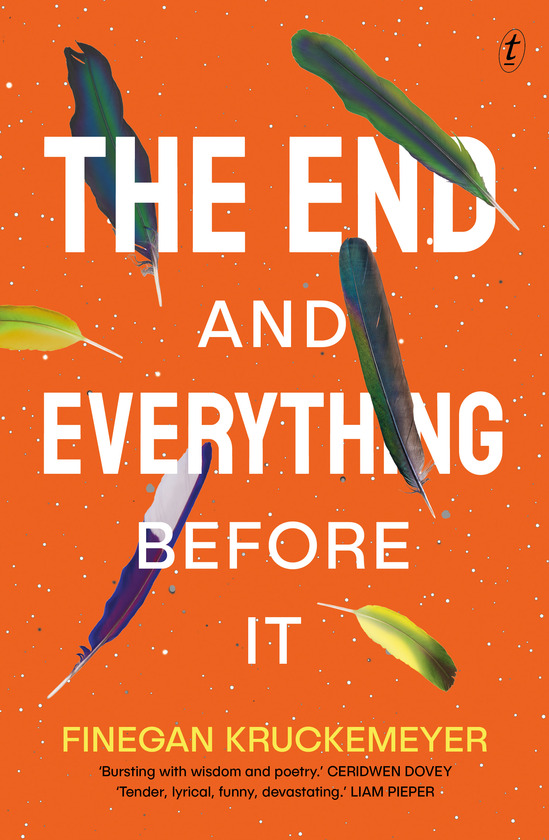
Emma watched her mother’s kayak disappear among icebergs in the Arctic Sea. Six years later, her brother, who had not spoken since their mother was lost, warns Emma of the curse of death that she brought to anyone who looked on her face—before tragedy befalls him too.
Emma consigns herself to a solitary life at sea, where she can do no more harm. After years alone, she is mysteriously drawn to land. And she docks at an island, afraid of what her arrival might mean for the welcoming man and his daughter waving from the jetty.
But who knows where our stories begin and end or how they are entwined? Who knows whether now, on the island, she begins a new tale—or takes a role in a story that began generations ago with a feast in the forest, or a chest of gold coins plunged into the sea, or an orphan in a bookshop beguiled by an elusive and troubled woman?
Review
Finegan Kruckemeyer’s debut novel resists easy classification. The back of the book presents minimal description: Emma, a woman convinced she brings death to those around her, chooses a life of solitude at sea. Yet, Emma is only one character amongst multiple generations—Isaac and Betty; Nella and Alistair; and eventually, Emma’s story interweaves with Conor, Liz, and their daughter, Anja.
The novel reads like a series of fables, layering the lives of its characters in mysterious ways. At first, the narrative’s nonlinear timeline and lack of specific location can be disorienting. I found myself confused in the book’s early chapters— for example, I pictured one story in some sort of ancient European setting, only to have a character casually reference wearing a hoodie. Yet, once I was able to orient myself, I could reflect on its deeper themes.
Kruckemeyer’s writing is poetic, filled with lines that shimmer with wit and wry observation. He explores the quiet strength of human connections, the complicated nature of grief, the legacies we leave behind, and the power of community to shape us across generations. Characters choose quiet contentment over material gain, and plant seeds—sometimes literally—for future generations:
Great wealth lies here if you want it. Great wealth is not great wealth if you don’t want it.
The end and everything before it.
However, the book’s format, favoring breadth over depth, may not be to everyone’s taste. Initially, I found myself struggling with the episodic nature of the narrative, which shifts between different characters and generations. I prefer books that allow more time to sit with fewer characters; as a result, I read this slowly until the final few chapters. Yet, if you enjoy a short story format, this book offers a rewarding reading experience.
In a world dominated by capitalism and individualistic priorities, The End and Everything Before It feels like a gentle reminder of what truly matters: our connections, our communities, and the legacies we create—not just for ourselves, but for those who come after us. This is a book that left me feeling unexpectedly hopeful about the world we live in.
Thank you to Text Publishing for the review copy.
Review by Elise
Has Novel Feelings entertained you, or taught you something? Show your support with a once-off donation by buying us a coffee. All proceeds go towards making the show stronger and more sustainable for the future.
 Novel Feelings